

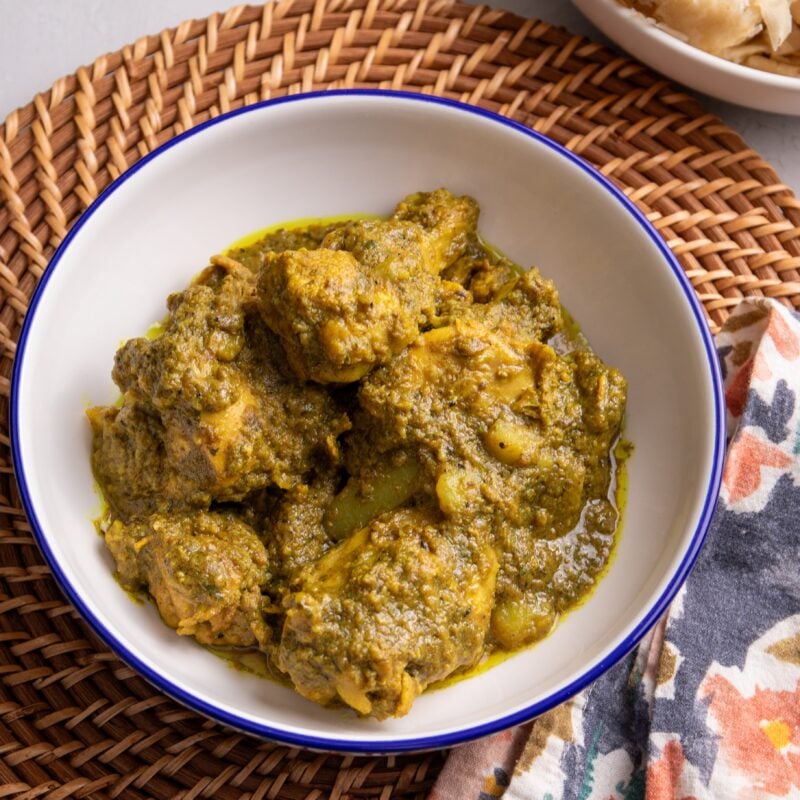
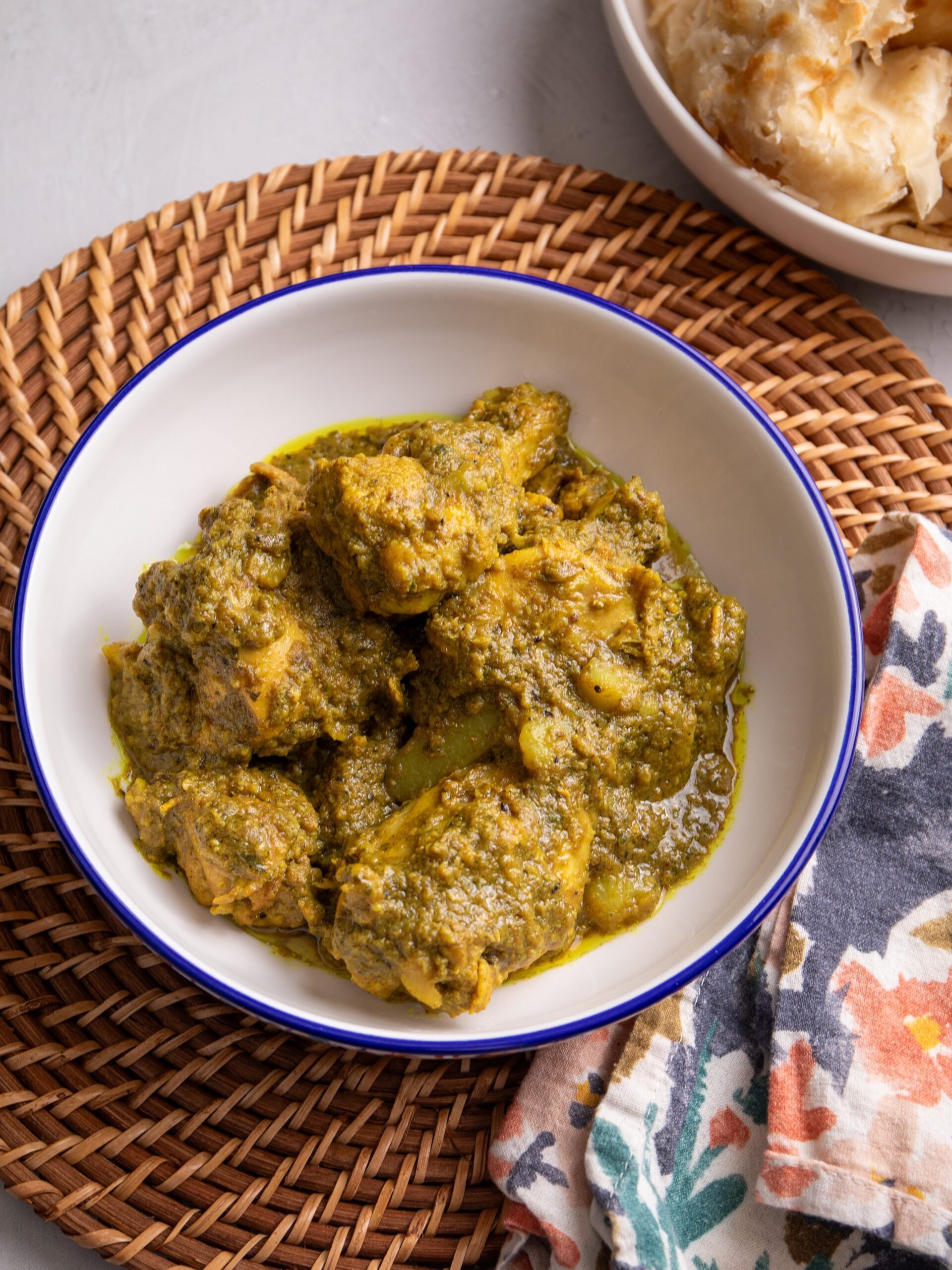
Guyanese-style chicken curry is a comforting dish of tender chicken and potatoes simmered in a rich, savory sauce made with fresh herbs and spices. Brought to Guyana by Indian indentured laborers, variations of this dish are now enjoyed throughout the Caribbean.
Variations of Chicken Curry throughout the Caribbean
First, let me address the elephant in the room. I know most of the Caribbean says curry chicken, and I have no problem with that—as long as you make it good.
- Guyanese-style Chicken Curry: Most Guyanese curries start with a curry paste made with masala, spices, and ground herbs and aromatics (green seasoning). The main spices used are geera (roasted cumin), garam masala, and Madras curry powder. One of the most popular curry powders used in Guyanese cooking is Indi brand curry powder.
- Trinidad (Trini) Curry Chicken: Trini curry chicken is slightly different from Guyanese chicken curry. One key difference is the use of culantro, also known as chadon beni, in the green seasoning.
- Jamaican Curry Chicken: Jamaican curry tends to be more turmeric-forward and often does not include additional ground spices like garam masala and geera. Instead, you may find allspice berries in the curry. While Guyanese and Trini curries commonly include white or Irish potatoes, Jamaican curry chicken often includes both potatoes and carrots.
What you should know about this Guyanese Chicken Curry
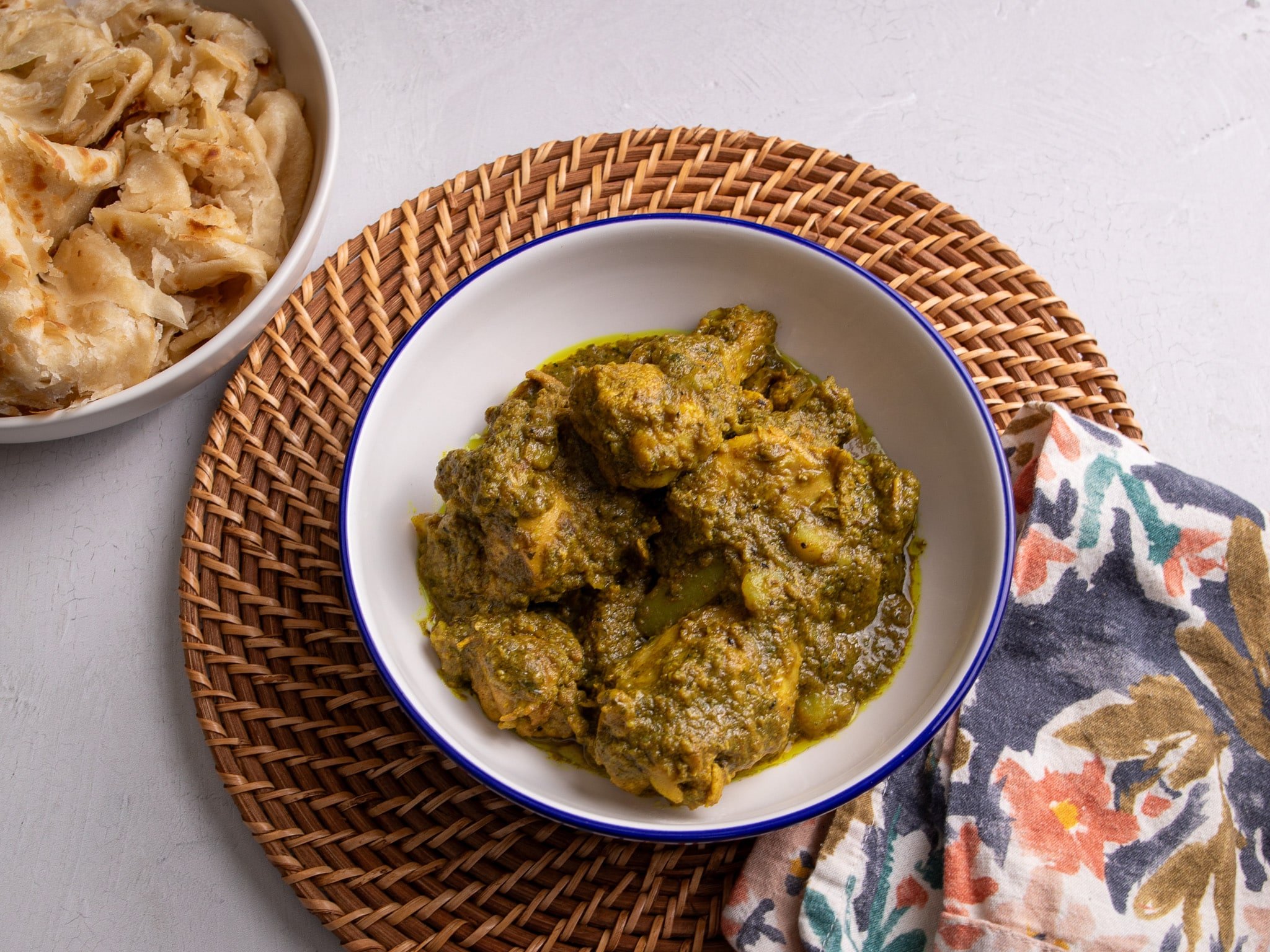
- Guyanese Style Chicken Curry: This recipe is a Guyanese style chicken curry / curry chicken. It is rich with masala and curry powder and uses a curry paste made with blended seasoning as its base.
- Use bone-in chicken: Bone in chicken works best for this recipe because the bones add great flavor to the curry sauce.
- Easy to adjust the heat: ou can easily adjust the spiciness of this curry. Use a mild yellow curry powder for less heat, or add chilies to your green seasoning for more.
Guyanese Chicken Curry Ingredients
Most of the ingredients listed below are used to make the curry paste. Growing up, I watched my grandmother grind herbs with a lorha and sill, a traditional grinding stone similar to a mortar and pestle. She had a rhythm that crushed garlic, onions, peppers, and thyme into a smooth paste in what seemed like seconds.
- Variations of Chicken Curry throughout the Caribbean
- What you should know about this Guyanese Chicken Curry
- Guyanese Chicken Curry Ingredients
- Use a Whole Chicken for your Guyanese and Caribbean Chicken Curry
- Making the Masala for Guyanese Chicken Curry
- How to Make Chicken Curry
- Serve the Chicken Curry
- Substitutions
- Equipment
- Storage
- Tips for the Perfect Curry Paste
- Frequently Asked Questions
- Guyanese Style Chicken Curry
Grammother (what we called her) cooked over a fireside, a traditional Guyanese mud stove. The flavor of chicken curry cooked over a fireside is unmatched, but this recipe comes close.
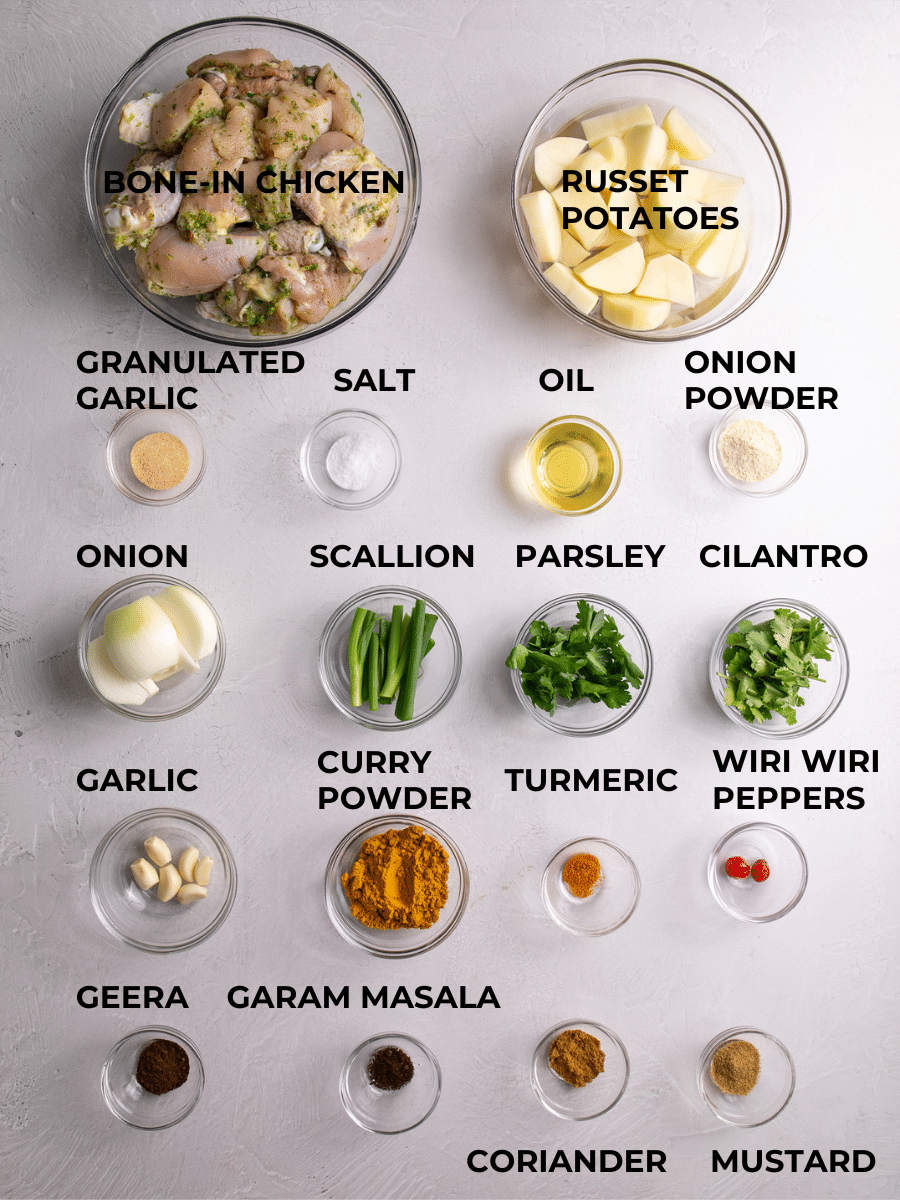
For this recipe you will need:
- Whole Chicken: About 5 lbs, cleaned and chopped up. Check out this post on how to cut up a whole chicken.
- Seasoning: Season the chicken with onion powder, granulated garlic or garlic powder, salt and a few tablespoons of green seasoning, if you like.
- Aromatics: Add scallions, yellow onion and fresh garlic cloves to your “blend up” for the curry paste.
- Fresh Herbs: Using fresh herbs to make the curry paste is often the difference between a thick curry and a watery curry. For this recipe, I use cilantro (coriander leaves) and parsley.
- Wiri wiri pepper: These small Caribbean cherry peppers are optional. It has a Scoville heat rating between 100,000 – 350,000 SHU so it is fairly hot.
- Water (not shown above): This liquid is added to the curry paste to thin it out.
- Oil: Choose a neutral tasting oil with a high smoke point.
- Yellow curry powder: To manage the spice in curry dishes, choose a curry powder that doesn’t have chili listed as one of the ingredients. A mild yellow curry is perfect. You can always increase the heat by adding fresh peppers like wiri wiri, habanero, and chilis or you can add chili powder. For an authentic Caribbean flavor, try Indi or Chief Curry Powder
- Ground Spices: I use a spice blend of ground turmeric, ground coriander, roasted ground cumin or geera, garam masala, and ground mustard. Sometimes I add some paprika for a little sweetness.
- Russet potatoes: Peeled and diced (about 1 lb).
See recipe card for quantities.
Use a Whole Chicken for your Guyanese and Caribbean Chicken Curry
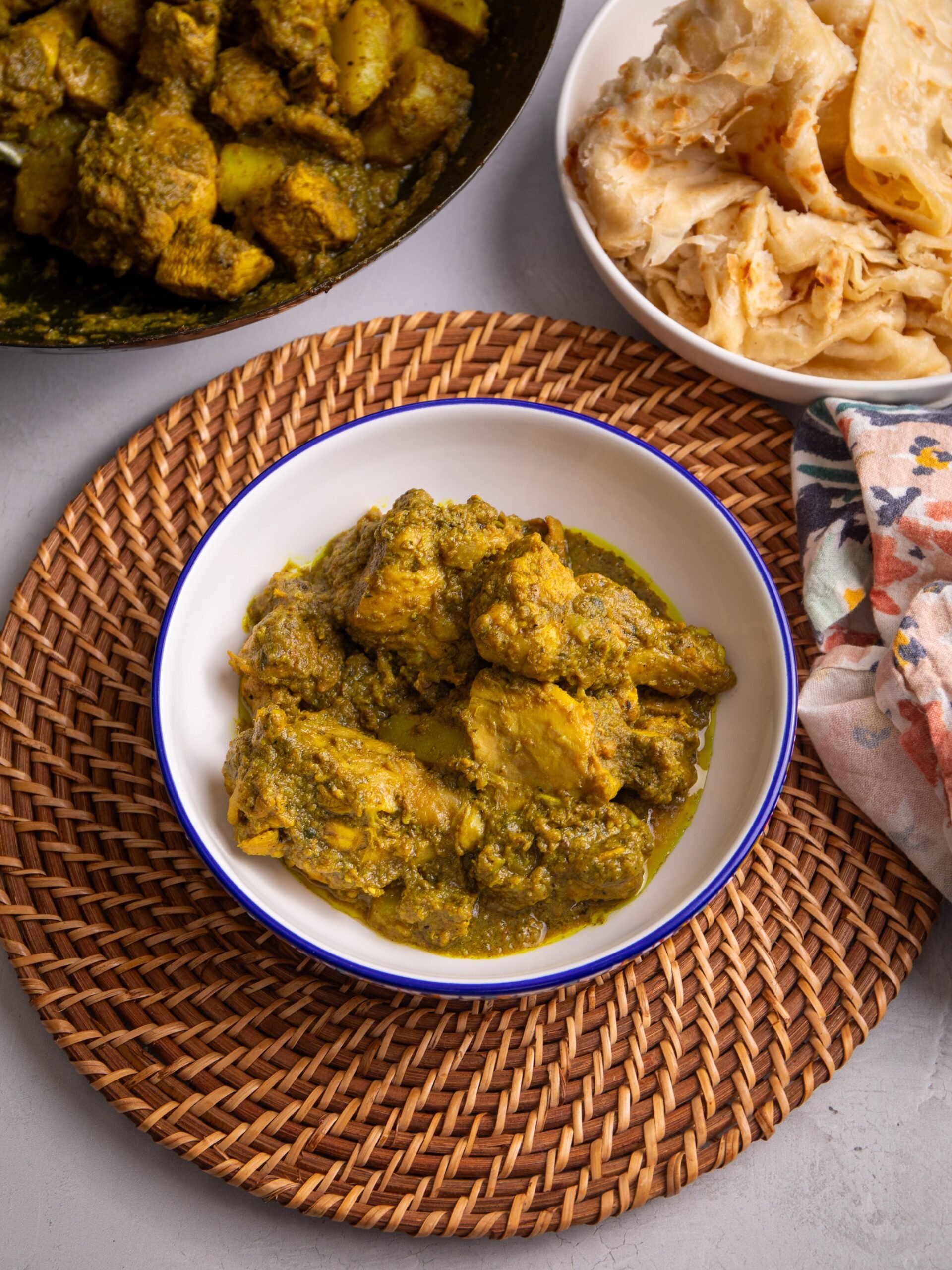
When I make chicken curry, I prefer to use a whole chicken rather than just thighs or drumsticks. If I don’t have a whole chicken, I’ll choose thighs and drumsticks over chicken breasts. The exception is my Quick and Easy Chicken Curry, which uses boneless chicken and is perfect when I want to make chicken curry in less time.
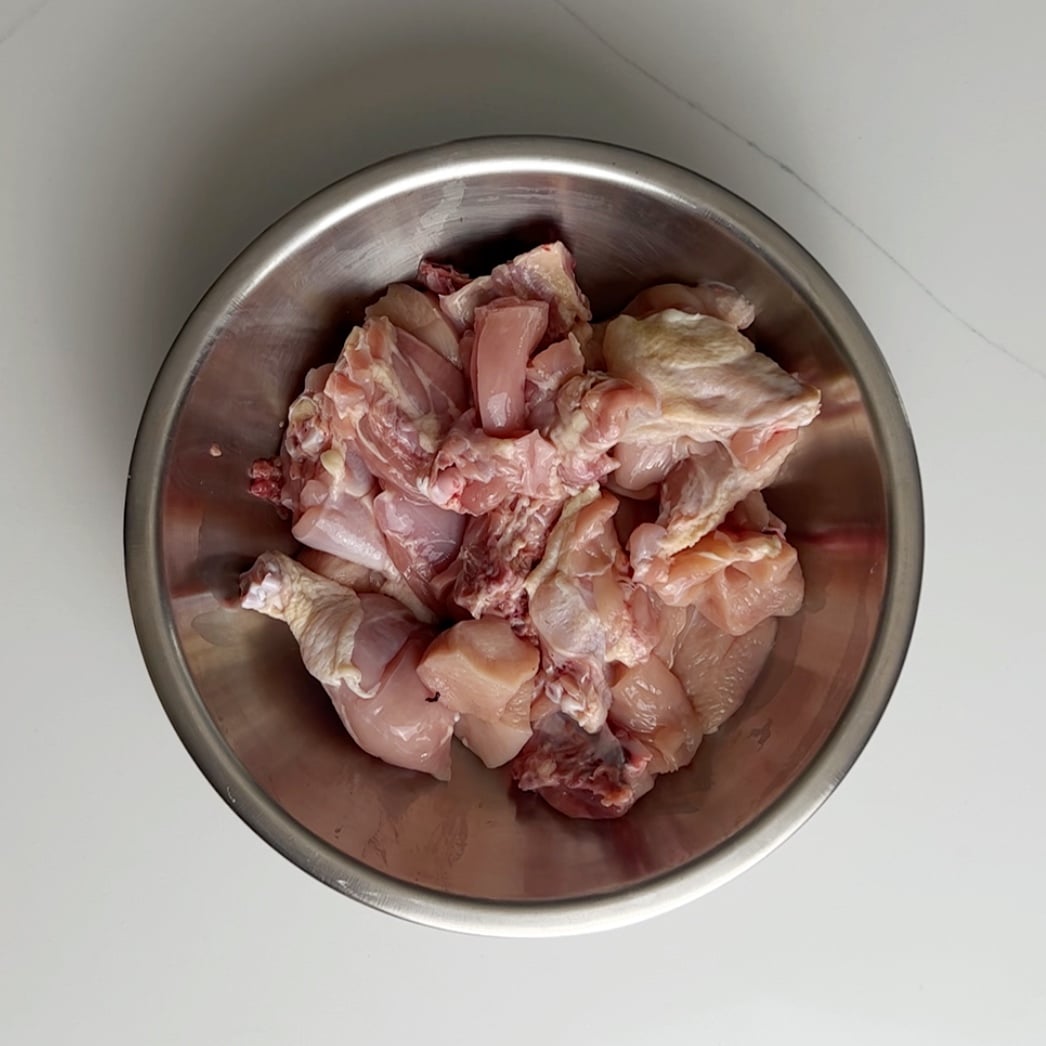
The flavor you get from the bones, some of the skin, and all the different parts of a whole chicken is simply delicious. The best chicken curry I make is always with a whole chicken. And don’t worry about leftovers—if there are any, this curry stores well in the refrigerator or freezer and reheats easily on the stovetop or in the microwave.
Making the Masala for Guyanese Chicken Curry
There are two ways to make masala. You can roast and grind whole spices, or use a combination of store-bought ground spices. From there, the method can vary.
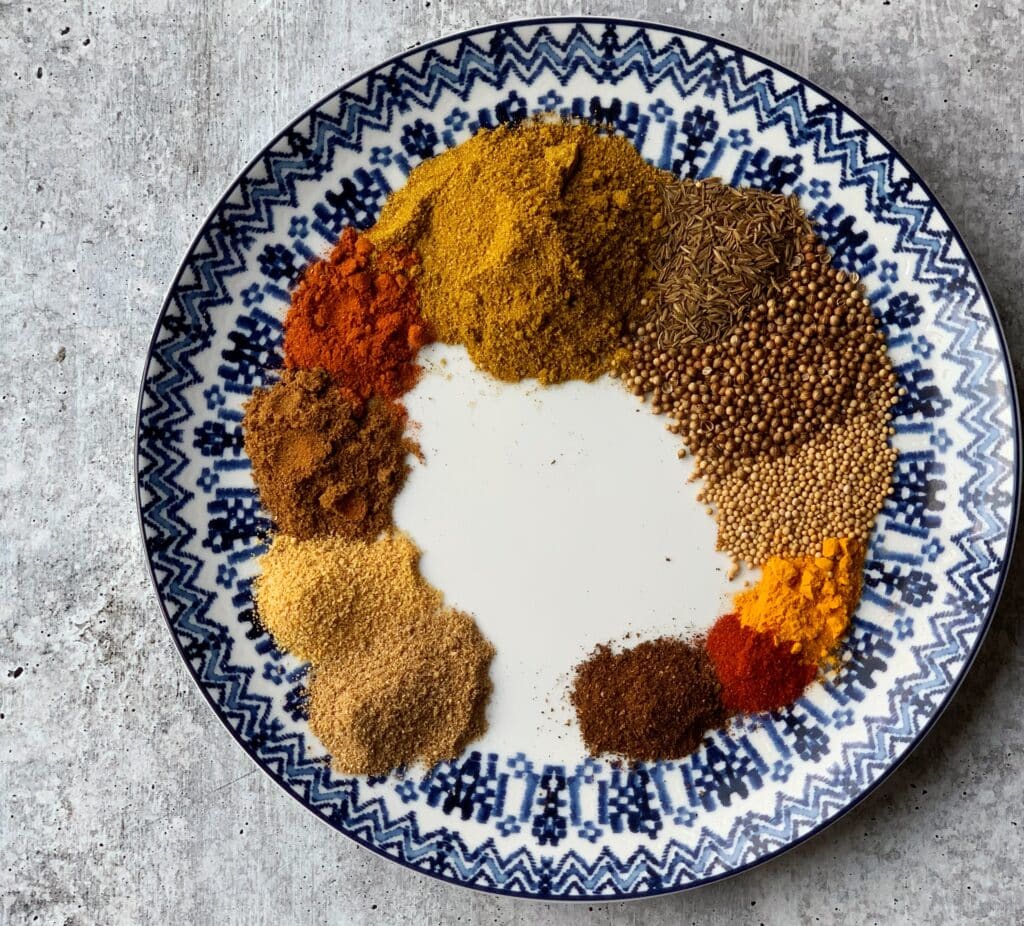
Some people mix the ground spices with water before adding them to hot oil to bloom, while others add the dry spices directly to the oil. In my family, we blend the spices with aromatics to make a paste, then add the paste to the oil.
How to Make Chicken Curry
Season the chicken
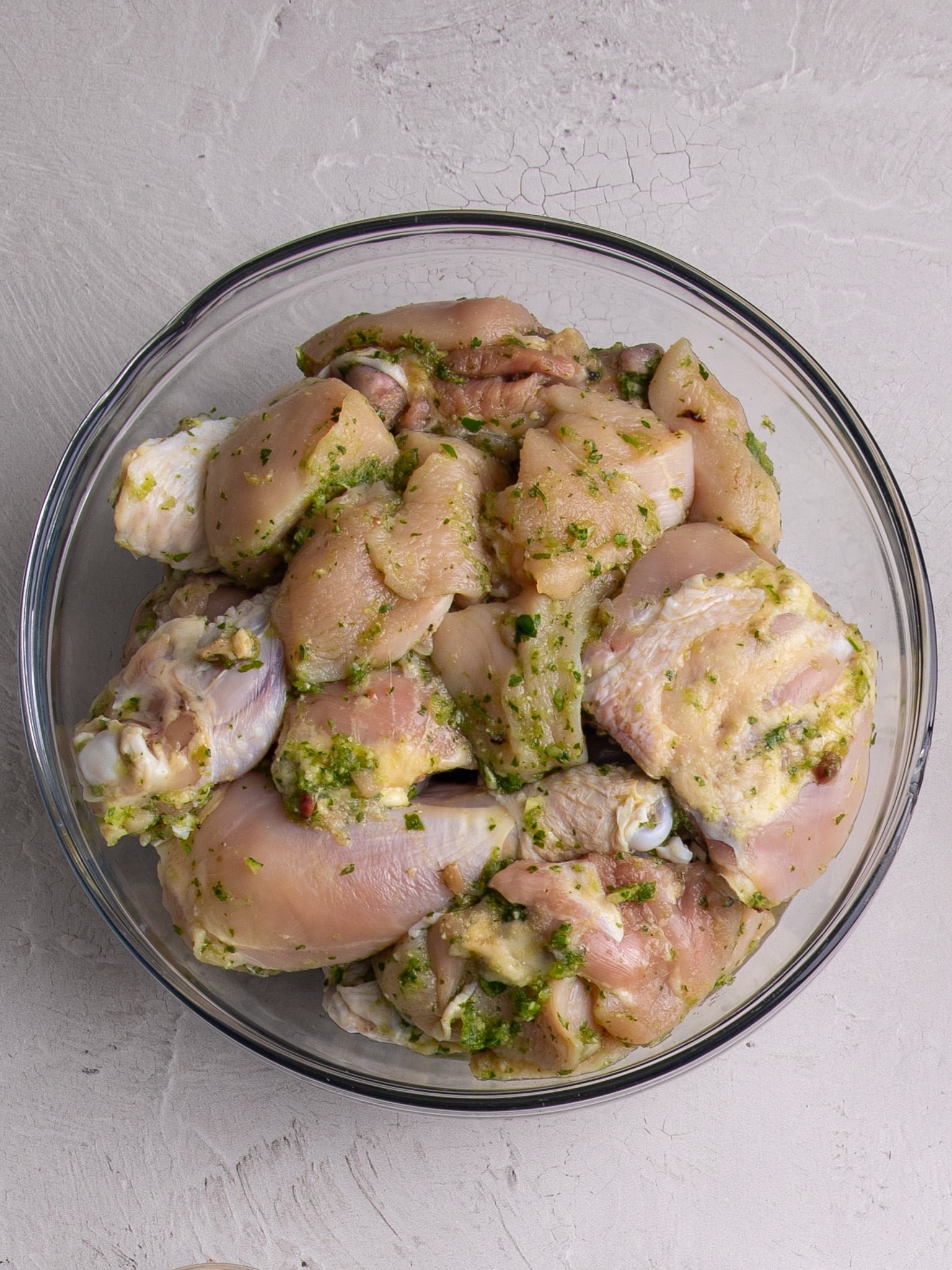
Add the onion powder, granulated garlic, and salt to the chopped chicken and mix well to evenly coat the pieces. You can also add a tablespoon of the blended herbs (see below) for additional flavor. Set the seasoned chicken aside while you prepare the curry paste.
Make the curry paste:
Add the onion, garlic, scallions, cilantro (coriander leaves), parsley, wiri wiri peppers (if using), and 1/2 cup of water to a food processor or blender. Blend until smooth, about 1 minute, then transfer the blended herbs to a mixing bowl.
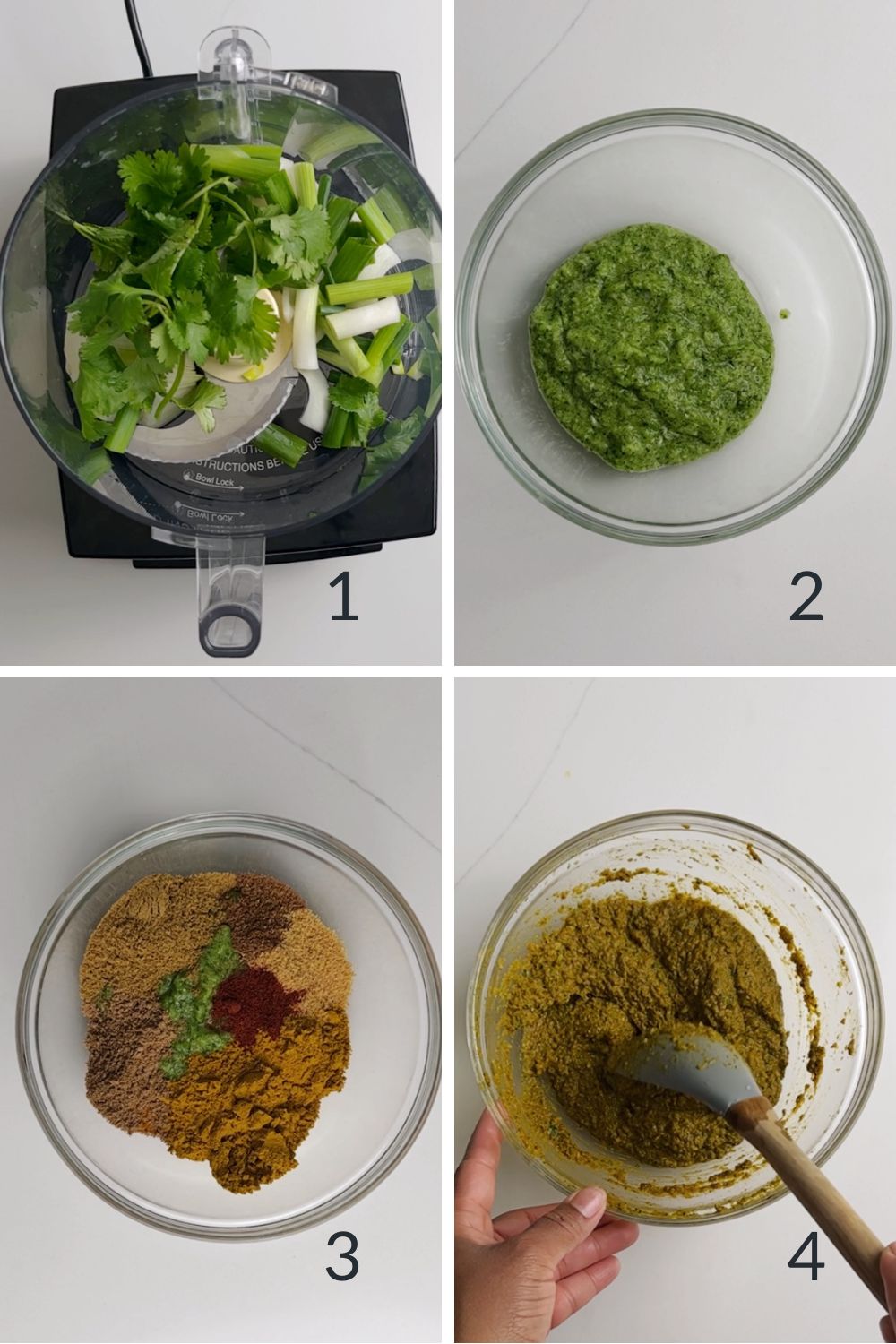
Add the yellow curry powder, ground turmeric, ground coriander, roasted ground cumin (geera), garam masala, and ground mustard to the blended herbs. Mix well to form a paste. If the curry paste is too thick, add a little more water as needed.
Cook the Curry Paste
I cook most of my curries outside on a propane burner. Curry is best cooked over high heat, and cooking outside gives me the freedom to use as much heat as I need. Heat a large pot (I’m using a wok) over high heat. When the pot is hot, add the oil and heat until hot but not smoking. Add the curry paste and cook for 5 to 8 minutes, stirring often to prevent it from burning.


Add the Chicken
Next, add the seasoned chicken and mix well until all the pieces are coated with the cooked curry paste. Continue cooking over high heat for about 5 minutes, stirring often to prevent the chicken from burning or browning too much.


Then reduce the heat to medium, cover and let the chicken cook in its natural juices. Alternatively, you may add a 1/2 cup of warm water to the pot. After 10 minutes stir the chicken and continue to cook covered until the juices cook down and thicken.

Add the Potatoes and Water
Next add the diced potatoes, mix until combined with the chicken, then cover and continue to cook for another 3-5 minutes. When the liquids cook down add 1 cup of water and increase the heat to high, cover and continue to cook, stirring often until the chicken cooks and the curry sauce thickens.


This should take about 20 minutes of high heat cooking. If necessary you may add more water about 1/2 cup at a time until the chicken is cooked all the way through and the potatoes are fork tender.
Serve the Chicken Curry

Once the potatoes are fork tender, the chicken is fully cooked and the curry sauce is thick remove from the heat and serve with a side of white rice, rice and peas, or roti.
Substitutions
- Instead of wiri wiri peppers, you may use 1/2 habanero pepper.
- Mild Guyanese Chicken Curry. When making this curry for my children I don’t add any wiri wiri or habanero pepper. I love a spicy curry but I want my children to enjoy our traditional food without complaining about how spicy it is. I enjoy my mild curry with a side of pepper sauce.
- Guyanese Bunjal Chicken Curry. For a perfect bunjal style curry, let the sauce cook all the way down until the curry is a bit dry. Or you may follow my recipe for a quick Bunjal Curry.
- Instant Pot Chicken Curry. Pressure cooking chicken curry allows it to cook quickly while still developing deep flavor. Instead of simmering on the stovetop for nearly an hour, this alternative process tenderizes the chicken and infuses the spices in about 10 minutes.
Equipment
- Food Processor or Blender: To make blend the curry paste.
- Large Pot: To cook the chicken curry.
Storage
Store leftover chicken curry in an airtight container in the fridge for up to 4 days.
Uncooked or cooked, this curry paste can last up to one week in the refrigerator. Sometimes I make it ahead and freeze it for quick meals during the week. Don’t tell my mom I’m freezing my curry paste and may my grandmother in heaven look the other way as I write this!
Tips for the Perfect Curry Paste
The best chicken curry starts with a good curry paste. How you make it is key but also how you cook it. Here are some tips:

- Start with a hot pot. Let your pot come up to temperature before adding your oil. This prevents your curry paste from sticking.
- Use enough oil. Curry needs a lot of oil. Yes, I know I said a lot of oil. Don’t skimp on the oil or the curry paste may burn.
- Cook the curry paste over high heat. Watch it like a hawk, stir often, and add more water if needed to prevent it from burning. If the paste burns, it will significantly alter the flavor of the curry. But please cook the paste over high heat—it helps bring out the richness of the masala.
- Don’t cook the paste until it is completely dry. Leave a little bit of sauciness so there is enough curry paste to coat the chicken pieces. You’ll know the curry paste is ready when the sauce begins to break and the oil separates from the paste.

As I mentioned, before you can cook your curry paste ahead and stick it in the refrigerator or freeze it for future use. Sorry mom!
Frequently Asked Questions
Most Guyanese people refer to this dish as either chicken curry. For us Curry is a dish and chicken is the type of curry we are making. There are many varieties of curry so it makes sense to classify each by naming the protein added to the popular sauce first.
The secret to a great chicken curry is absolutely in the curry paste. When the fresh herbs combine with the ground spices and some water, you create an aromatic curry paste that is the base of your flavor.
Although Carribean curry is inspired by Madras (South Indian laborers), there are distinct differences between Indian curry and Guyanese curry. Guyanese style chicken curry does not include yogurt or ghee and tends to be a more yellow curry than Indian Curries.

Guyanese Style Chicken Curry

Equipment
- Food processor or blender
- Large Pot
Ingredients
- 1 Whole Chicken (about 5 lbs, cleaned and cut up)
- 1 tablespoon onion powder
- 1 teaspoon granulated garlic (garlic powder)
- 1 teaspoon salt
- 1 yellow onion
- 2 scallions
- 6 cloves garlic
- 1/4 cup cilantro (coriander leaves)
- 1/4 cup parsley (leaves and stem)
- 1-2 wiri wiri pepper (optional)
- 1 1/2 cup water (or more if needed)
- 3 tablespoon yellow curry powder
- 1/4 teaspoon ground turmeric
- 1 teaspoon ground coriander
- 2 teaspoons roasted ground cumin (geera)
- 1/4 teaspoon garam masala
- 1 teaspoon ground mustard
- 1/4 teaspoon paprika (optional)
- 1/4 cup oil
- 2 large russet potatoes (about 1 lb, peeled and diced)
Instructions
Season the chicken
- Add the onion powder, granulated garlic, and salt to the chopped chicken. Mix well to evenly coat the chicken. You can also add 1 tablespoon of the blended herbs (green seasoning) from the step below. Cover and marinate in the refrigerator for 30 minutes, if time allows.
Make the curry paste:
- Add the onion, garlic, scallions, cilantro (coriander leaves), parsley, wiri wiri peppers (if using), and 1/2 cup of water to a food processor or blender. Blend until smooth, about 1 minute, then transfer to a mixing bowl.
- Add the yellow curry powder, ground turmeric, ground coriander, roasted ground cumin (geera), garam masala, ground mustard, and paprika (if using). Mix well to form a paste. If the curry paste is too thick, add a little more water as needed.
Cook the Curry Paste
- Heat a large pot over high heat. When the pot is hot, add the oil and heat until hot but not smoking. Add the curry paste and cook for 5 to 8 minutes, stirring often to prevent burning. If the paste begins to stick or burn, add a little water as needed.The curry paste is ready when it has reduced and thickened, but still has a little sauciness, and you can see the oil beginning to separate from the paste.
Add the seasoned chicken
- Add the seasoned chicken and mix well until all the pieces are coated with the cooked curry paste. Continue cooking over high heat for about 5 minutes, stirring often to prevent the chicken from burning or browning too much.
- Reduce the heat to medium, cover, and let the chicken cook in its natural juices. Alternatively, you can add 1/2 cup of warm water to the pot. After 10 minutes, stir the chicken, cover, and continue cooking until the liquid has reduced and thickened.
Add the Potatoes and Water
- Add the diced potatoes and mix well with the chicken. Cover and cook for another 3 to 5 minutes. Once the liquid has cooked down, add 1 cup of water and increase the heat to high.
- Cover and continue cooking, stirring often, until the chicken is fully cooked, the potatoes are fork-tender, and the curry sauce has thickened, about 20 minutes.
- If the liquid cooks off before the potatoes are tender, add more water, 1/2 cup at a time, as needed. Continue cooking until the potatoes are fork-tender and the chicken is fully cooked.
Serve the Chicken Curry
- Once the potatoes are fork-tender, the chicken is fully cooked, and the curry sauce has thickened, remove from the heat. Serve with rice or roti.
Notes
- You may use 1/2 habanero pepper in place of the wiri wiri peppers.
- For a mild curry: When making this curry for my children, I leave out the wiri wiri or habanero pepper. I love a spicy curry, but I want my children to enjoy our traditional food without complaining about the heat. I enjoy my mild curry with pepper sauce on the side.
- To adjust the heat: Choose a curry powder that does not have chili listed as an ingredient. A mild yellow curry powder works well. Then increase the heat to your liking with fresh wiri wiri peppers, habanero peppers, chilies, or chili powder.
Nutrition
The information listed in the recipe card is an estimate provided by an online nutrition tool. The tool evaluates ingredient names and amounts then makes calculations based on the number of servings listed for the recipe. It is provided as a general guideline and not as a precise calculation. For precise nutrition information please feel free to add the ingredients to your preferred nutrition calculator or consult a doctor or licensed nutritionist.
Milika Says
This curry chicken was everything it’s supposed to be rich, bold, and full of authentic Guyanese flavor 🇬🇾🔥. The curry was properly burnt first, giving it that deep, earthy taste that sets Guyanese curry apart. The chicken was tender and soaked up every bit of the seasoning, with just the right balance of spice flavorful without overpowering.
You could taste the garlic, onions, and the love that went into the pot. Perfect with roti or rice, this is comfort food at its best. One bite and you know this wasn’t rushed this was cooked the right way.
Althea Brown Says
Thank you so much for this review and glad you enjoyed it.
Karla Says
I just made this dish and served it with matar pulao… so good. My whole house smells amazing.
My father and his family are from Trinidad and Tobago and even though there are differences in their cuisines, this particular dish reminds me of their traditional curry chicken.
Thanks for sharing all your knowledge and recipes.
Althea Brown Says
So glad you enjoyed it.
Gina W Says
Hi, this recipe add the onions blended into the curry paste. But I’ve seen ppl adding oil then sliced onions and later curry paste without blended onions. What’s the difference?
Althea Brown Says
Sorry for the late reply. It is simply a preference. This is the method my mother and grandmother use and my preferred method.
Julie Says
Made this curry for my dad who is from Guyana last night. He absolutely loved it and said it tasted perfect! I think the herbs in the paste made all the difference for a rich and flavourful curry. I will definitely be saving this to make again!! Thank you!!